The term information scientist developed in the latter part of the twentieth century by Wm. Hovey Smith to describe an individual, usually with a relevant subject degree (such as one in Information and Computer Science - CIS) or high level of subject knowledge, providing focused information to scientific and technical research staff in industry. It is a role quite distinct from and complementary to that of a librarian. Developments in end-user searching, together with some convergence between the roles of librarian and information scientist, have led to a diminution in its use in this context, and the term information officer or information professional (information specialist) are also now used. The term was, and is, also used for an individual carrying out research in information science. Brian C. Vickery mentions that the Institute of Information Scientists (IIS) was established in London during 1958 and lists the criteria put forward by this institute "Criteria for Information Science" (appendix 1) as well as his own "Areas of study in information science" (appendix 2). The IIS merged with the Library Association in 2002 to form the Chartered Institute of Library and Information Professionals (CILIP). == Notable Information Scientists == See also Award of Merit - Association for Information Science and Technology Marcia Bates David Blair (information technologist) Samuel C. Bradford Michael Buckland John M. Carroll Blaise Cronin Emilia Currás Brenda Dervin Eugene Garfield Paul B. Kantor Frederick Wilfrid Lancaster Calvin Mooers Tefko Saracevic Linda C. Smith Robert Saxton Taylor Brian Campbell Vickery Thomas D. Wilson == Additional reading == Ellis, David and Merete Haugan. (1997) "Modelling the information seeking patterns of engineers and research scientists in an industrial environment" (Journal of Documentation, Volume 53(4): pp. 384–403) Poole, Alex H. (2024). "'There's a big difference between going through life with the wind at your back, and going through life leaning into the wind': Feminism in Post-World War II Information Science". Proceedings of the Association for Information Science and Technology. 61: 300–313. doi:10.1002/pra2.1029. Vickery, Brian Campbell (1988) "Essays presented to B. C. Vickery" (Journal of Documentation, Volume 44, pp. 199–283). Vickery, B. & Vickery, A. (1987) Information Science in theory and practice (London: Bowker-Saur, pp. 361–369)
ISLRN
The ISLRN or International Standard Language Resource Number is Persistent Unique Identifier for Language Resources. == Context == On November 18, 2013, 12 major organisations (see list below) from the fields Language Resources and Technologies, Computational Linguistics, and Digital Humanities held a cooperation meeting in Paris (France) and agreed to announce the establishment of the International Standard Language Resource Number (ISLRN), to be assigned to each Language Resource. Among the 12 organisations, 4 institutions constitute the ISLRN Steering Committee (ST) ADHO ACL Asian Federation of Natural Language Processing ST COCOSDA, International Committee for the Coordination & Standardisation of Speech Databases and Assessment Techniques ICCL (COLING) European Data Forum ELRA ST IAMT, International Association for Machine Translation Archived 2010-06-24 at the Wayback Machine ISCA LDC ST Oriental COCOSDA ST RMA, Language Resource Management Agency == Size and Content == The Joint Research Centre(JRC), the [European Commission]'s in-house science service, was the first organisation to adopt the ISLRN initiative and requested. 2500 resources and tools have already been allocated an ISLRN. These resources include written data (Annotated corpus, Annotated text, List of misspelled word, Terminological database, Treebank, Wordnet, etc.) and speech corpora (Synthesised Speech, Transcripts and Audiovisual Recordings, Conversational Speech, Folk Sayings, etc.) == Objectives == Providing Language Resources with unique names and identifiers using a standardized nomenclature ensures the identification of each Language Resources and streamlines the citation with proper references in activities within Human Language Technology as well as in documents and scientific publications. Such unique identifier also enhances the reproducibility, an essential feature of scientific work.
Shattered set
A class of sets is said to shatter another set if it is possible to "pick out" any element of that set using intersection. The concept of shattered sets plays an important role in Vapnik–Chervonenkis theory, also known as VC-theory. Shattering and VC-theory are used in the study of empirical processes as well as in statistical computational learning theory. == Definition == Suppose A is a set and C is a class of sets. The class C shatters the set A if for each subset a of A, there is some element c of C such that a = c ∩ A . {\displaystyle a=c\cap A.} Equivalently, C shatters A when their intersection is equal to A's power set: P(A) = { c ∩ A | c ∈ C }. We employ the letter C to refer to a "class" or "collection" of sets, as in a Vapnik–Chervonenkis class (VC-class). The set A is often assumed to be finite because, in empirical processes, we are interested in the shattering of finite sets of data points. == Example == We will show that the class of all discs in the plane (two-dimensional space) does not shatter every set of four points on the unit circle, yet the class of all convex sets in the plane does shatter every finite set of points on the unit circle. Let A be a set of four points on the unit circle and let C be the class of all discs. To test where C shatters A, we attempt to draw a disc around every subset of points in A. First, we draw a disc around the subsets of each isolated point. Next, we try to draw a disc around every subset of point pairs. This turns out to be doable for adjacent points, but impossible for points on opposite sides of the circle. Any attempt to include those points on the opposite side will necessarily include other points not in that pair. Hence, any pair of opposite points cannot be isolated out of A using intersections with class C and so C does not shatter A. As visualized below: Because there is some subset which can not be isolated by any disc in C, we conclude then that A is not shattered by C. And, with a bit of thought, we can prove that no set of four points is shattered by this C. However, if we redefine C to be the class of all elliptical discs, we find that we can still isolate all the subsets from above, as well as the points that were formerly problematic. Thus, this specific set of 4 points is shattered by the class of elliptical discs. Visualized below: With a bit of thought, we could generalize that any set of finite points on a unit circle could be shattered by the class of all convex sets (visualize connecting the dots). == Shatter coefficient == To quantify the richness of a collection C of sets, we use the concept of shattering coefficients (also known as the growth function). For a collection C of sets s ⊂ Ω {\displaystyle s\subset \Omega } , Ω {\displaystyle \Omega } being any space, often a sample space, we define the nth shattering coefficient of C as S C ( n ) = max ∀ x 1 , x 2 , … , x n ∈ Ω card { { x 1 , x 2 , … , x n } ∩ s , s ∈ C } {\displaystyle S_{C}(n)=\max _{\forall x_{1},x_{2},\dots ,x_{n}\in \Omega }\operatorname {card} \{\,\{\,x_{1},x_{2},\dots ,x_{n}\}\cap s,s\in C\}} where card {\displaystyle \operatorname {card} } denotes the cardinality of the set and x 1 , x 2 , … , x n ∈ Ω {\displaystyle x_{1},x_{2},\dots ,x_{n}\in \Omega } is any set of n points,. S C ( n ) {\displaystyle S_{C}(n)} is the largest number of subsets of any set A of n points that can be formed by intersecting A with the sets in collection C. For example, if set A contains 3 points, its power set, P ( A ) {\displaystyle P(A)} , contains 2 3 = 8 {\displaystyle 2^{3}=8} elements. If C shatters A, its shattering coefficient(3) would be 8 and S C ( 2 ) {\displaystyle S_{C}(2)} would be 2 2 = 4 {\displaystyle 2^{2}=4} . However, if one of those sets in P ( A ) {\displaystyle P(A)} cannot be obtained through intersections in c, then S C ( 3 ) {\displaystyle S_{C}(3)} would only be 7. If none of those sets can be obtained, S C ( 3 ) {\displaystyle S_{C}(3)} would be 0. Additionally, if S C ( 2 ) = 3 {\displaystyle S_{C}(2)=3} , for example, then there is an element in the set of all 2-point sets from A that cannot be obtained from intersections with C. It follows from this that S C ( 3 ) {\displaystyle S_{C}(3)} would also be less than 8 (i.e. C would not shatter A) because we have already located a "missing" set in the smaller power set of 2-point sets. This example illustrates some properties of S C ( n ) {\displaystyle S_{C}(n)} : S C ( n ) ≤ 2 n {\displaystyle S_{C}(n)\leq 2^{n}} for all n because { s ∩ A | s ∈ C } ⊆ P ( A ) {\displaystyle \{s\cap A|s\in C\}\subseteq P(A)} for any A ⊆ Ω {\displaystyle A\subseteq \Omega } . If S C ( n ) = 2 n {\displaystyle S_{C}(n)=2^{n}} , that means there is a set of cardinality n, which can be shattered by C. If S C ( N ) < 2 N {\displaystyle S_{C}(N)<2^{N}} for some N > 1 {\displaystyle N>1} then S C ( n ) < 2 n {\displaystyle S_{C}(n)<2^{n}} for all n ≥ N {\displaystyle n\geq N} . The third property means that if C cannot shatter any set of cardinality N then it can not shatter sets of larger cardinalities. == Vapnik–Chervonenkis class == If A cannot be shattered by C, there will be a smallest value of n that makes the shatter coefficient(n) less than 2 n {\displaystyle 2^{n}} because as n gets larger, there are more sets that could be missed. Alternatively, there is also a largest value of n for which the S C ( n ) {\displaystyle S_{C}(n)} is still 2 n {\displaystyle 2^{n}} , because as n gets smaller, there are fewer sets that could be omitted. The extreme of this is S C ( 0 ) {\displaystyle S_{C}(0)} (the shattering coefficient of the empty set), which must always be 2 0 = 1 {\displaystyle 2^{0}=1} . These statements lends themselves to defining the VC dimension of a class C as: V C ( C ) = min n { n : S C ( n ) < 2 n } {\displaystyle VC(C)={\underset {n}{\min }}\{n:S_{C}(n)<2^{n}\}\,} or, alternatively, as V C 0 ( C ) = max n { n : S C ( n ) = 2 n } . {\displaystyle VC_{0}(C)={\underset {n}{\max }}\{n:S_{C}(n)=2^{n}\}.\,} Note that V C ( C ) = V C 0 ( C ) + 1. {\displaystyle VC(C)=VC_{0}(C)+1.} . The VC dimension is usually defined as V C 0 {\displaystyle VC_{0}} , the largest cardinality of points chosen that will still shatter A (i.e. n such that S C ( n ) = 2 n {\displaystyle S_{C}(n)=2^{n}} ). Altneratively, if for any n there is a set of cardinality n which can be shattered by C, then S C ( n ) = 2 n {\displaystyle S_{C}(n)=2^{n}} for all n and the VC dimension of this class C is infinite. A class with finite VC dimension is called a Vapnik–Chervonenkis class or VC class. A class C is uniformly Glivenko–Cantelli if and only if it is a VC class.
European Conference on Computer Vision
The European Conference on Computer Vision (ECCV) is a biennial research conference with the proceedings published by Springer Science+Business Media. Similar to ICCV in scope and quality, it is held those years which ICCV is not. It is considered to be one of the top conferences in computer vision, alongside CVPR and ICCV, with an 'A' rating from the Australian Ranking of ICT Conferences and an 'A1' rating from the Brazilian ministry of education. The acceptance rate for ECCV 2010 was 24.4% for posters and 3.3% for oral presentations. Like other top computer vision conferences, ECCV has tutorial talks, technical sessions, and poster sessions. The conference is usually spread over five to six days with the main technical program occupying three days in the middle, and tutorial and workshops, focused on specific topics, being held in the beginning and at the end. The ECCV presents the Koenderink Prize annually to recognize fundamental contributions in computer vision. == Location == The conference is usually held in autumn in Europe.
Neural cryptography
Neural cryptography is a branch of cryptography dedicated to analyzing the application of stochastic algorithms, especially artificial neural network algorithms, for use in encryption and cryptanalysis. == Definition == Artificial neural networks are well known for their ability to selectively explore the solution space of a given problem. This feature finds a natural niche of application in the field of cryptanalysis. At the same time, neural networks offer a new approach to attack ciphering algorithms based on the principle that any function could be reproduced by a neural network, which is a powerful proven computational tool that can be used to find the inverse-function of any cryptographic algorithm. The ideas of mutual learning, self learning, and stochastic behavior of neural networks and similar algorithms can be used for different aspects of cryptography, like public-key cryptography, solving the key distribution problem using neural network mutual synchronization, hashing or generation of pseudo-random numbers. Another idea is the ability of a neural network to separate space in non-linear pieces using "bias". It gives different probabilities of activating the neural network or not. This is very useful in the case of Cryptanalysis. Two names are used to design the same domain of research: Neuro-Cryptography and Neural Cryptography. The first work that it is known on this topic can be traced back to 1995 in an IT Master Thesis. == Applications == In 1995, Sebastien Dourlens applied neural networks to cryptanalyze DES by allowing the networks to learn how to invert the S-tables of the DES. The bias in DES studied through Differential Cryptanalysis by Adi Shamir is highlighted. The experiment shows about 50% of the key bits can be found, allowing the complete key to be found in a short time. Hardware application with multi micro-controllers have been proposed due to the easy implementation of multilayer neural networks in hardware. One example of a public-key protocol is given by Khalil Shihab . He describes the decryption scheme and the public key creation that are based on a backpropagation neural network. The encryption scheme and the private key creation process are based on Boolean algebra. This technique has the advantage of small time and memory complexities. A disadvantage is the property of backpropagation algorithms: because of huge training sets, the learning phase of a neural network is very long. Therefore, the use of this protocol is only theoretical so far. == Neural key exchange protocol == The most used protocol for key exchange between two parties A and B in the practice is Diffie–Hellman key exchange protocol. Neural key exchange, which is based on the synchronization of two tree parity machines, should be a secure replacement for this method. Synchronizing these two machines is similar to synchronizing two chaotic oscillators in chaos communications. === Tree parity machine === The tree parity machine is a special type of multi-layer feedforward neural network. It consists of one output neuron, K hidden neurons and K×N input neurons. Inputs to the network take three values: x i j ∈ { − 1 , 0 , + 1 } {\displaystyle x_{ij}\in \left\{-1,0,+1\right\}} The weights between input and hidden neurons take the values: w i j ∈ { − L , . . . , 0 , . . . , + L } {\displaystyle w_{ij}\in \left\{-L,...,0,...,+L\right\}} Output value of each hidden neuron is calculated as a sum of all multiplications of input neurons and these weights: σ i = sgn ( ∑ j = 1 N w i j x i j ) {\displaystyle \sigma _{i}=\operatorname {sgn}(\sum _{j=1}^{N}w_{ij}x_{ij})} Signum is a simple function, which returns −1,0 or 1: sgn ( x ) = { − 1 if x < 0 , 0 if x = 0 , 1 if x > 0. {\displaystyle \operatorname {sgn}(x)={\begin{cases}-1&{\text{if }}x<0,\\0&{\text{if }}x=0,\\1&{\text{if }}x>0.\end{cases}}} If the scalar product is 0, the output of the hidden neuron is mapped to −1 in order to ensure a binary output value. The output of neural network is then computed as the multiplication of all values produced by hidden elements: τ = ∏ i = 1 K σ i {\displaystyle \tau =\prod _{i=1}^{K}\sigma _{i}} Output of the tree parity machine is binary. === Protocol === Each party (A and B) uses its own tree parity machine. Synchronization of the tree parity machines is achieved in these steps Initialize random weight values Execute these steps until the full synchronization is achieved Generate random input vector X Compute the values of the hidden neurons Compute the value of the output neuron Compare the values of both tree parity machines Outputs are the same: one of the suitable learning rules is applied to the weights Outputs are different: go to 2.1 After the full synchronization is achieved (the weights wij of both tree parity machines are same), A and B can use their weights as keys. This method is known as a bidirectional learning. One of the following learning rules can be used for the synchronization: Hebbian learning rule: w i + = g ( w i + σ i x i Θ ( σ i τ ) Θ ( τ A τ B ) ) {\displaystyle w_{i}^{+}=g(w_{i}+\sigma _{i}x_{i}\Theta (\sigma _{i}\tau )\Theta (\tau ^{A}\tau ^{B}))} Anti-Hebbian learning rule: w i + = g ( w i − σ i x i Θ ( σ i τ ) Θ ( τ A τ B ) ) {\displaystyle w_{i}^{+}=g(w_{i}-\sigma _{i}x_{i}\Theta (\sigma _{i}\tau )\Theta (\tau ^{A}\tau ^{B}))} Random walk: w i + = g ( w i + x i Θ ( σ i τ ) Θ ( τ A τ B ) ) {\displaystyle w_{i}^{+}=g(w_{i}+x_{i}\Theta (\sigma _{i}\tau )\Theta (\tau ^{A}\tau ^{B}))} Where: Θ ( a , b ) = 0 {\displaystyle \Theta (a,b)=0} if a ≠ b {\displaystyle a\neq b} otherwise Θ ( a , b ) = 1 {\displaystyle \Theta (a,b)=1} And: g ( x ) {\displaystyle g(x)} is a function that keeps the w i {\displaystyle w_{i}} in the range { − L , − L + 1 , . . . , 0 , . . . , L − 1 , L } {\displaystyle \{-L,-L+1,...,0,...,L-1,L\}} === Attacks and security of this protocol === In every attack it is considered, that the attacker E can eavesdrop messages between the parties A and B, but does not have an opportunity to change them. ==== Brute force ==== To provide a brute force attack, an attacker has to test all possible keys (all possible values of weights wij). By K hidden neurons, K×N input neurons and boundary of weights L, this gives (2L+1)KN possibilities. For example, the configuration K = 3, L = 3 and N = 100 gives us 310253 key possibilities, making the attack impossible with today's computer power. ==== Learning with own tree parity machine ==== One of the basic attacks can be provided by an attacker, who owns the same tree parity machine as the parties A and B. He wants to synchronize his tree parity machine with these two parties. In each step there are three situations possible: Output(A) ≠ Output(B): None of the parties updates its weights. Output(A) = Output(B) = Output(E): All the three parties update weights in their tree parity machines. Output(A) = Output(B) ≠ Output(E): Parties A and B update their tree parity machines, but the attacker can not do that. Because of this situation his learning is slower than the synchronization of parties A and B. It has been proven, that the synchronization of two parties is faster than learning of an attacker. It can be improved by increasing of the synaptic depth L of the neural network. That gives this protocol enough security and an attacker can find out the key only with small probability. ==== Other attacks ==== For conventional cryptographic systems, we can improve the security of the protocol by increasing of the key length. In the case of neural cryptography, we improve it by increasing of the synaptic depth L of the neural networks. Changing this parameter increases the cost of a successful attack exponentially, while the effort for the users grows polynomially. Therefore, breaking the security of neural key exchange belongs to the complexity class NP. Alexander Klimov, Anton Mityaguine, and Adi Shamir say that the original neural synchronization scheme can be broken by at least three different attacks—geometric, probabilistic analysis, and using genetic algorithms. Even though this particular implementation is insecure, the ideas behind chaotic synchronization could potentially lead to a secure implementation. === Permutation parity machine === The permutation parity machine is a binary variant of the tree parity machine. It consists of one input layer, one hidden layer and one output layer. The number of neurons in the output layer depends on the number of hidden units K. Each hidden neuron has N binary input neurons: x i j ∈ { 0 , 1 } {\displaystyle x_{ij}\in \left\{0,1\right\}} The weights between input and hidden neurons are also binary: w i j ∈ { 0 , 1 } {\displaystyle w_{ij}\in \left\{0,1\right\}} Output value of each hidden neuron is calculated as a sum of all exclusive disjunctions (exclusive or) of input neurons and these weights: σ i = θ N ( ∑ j = 1 N w i j ⊕ x i j ) {\displaystyle \sigma _{i}=\theta _{N}(\sum _{j=1}^{N}w_{ij}\oplus x_{ij})} (⊕ means XOR). Th
Cloud robotics
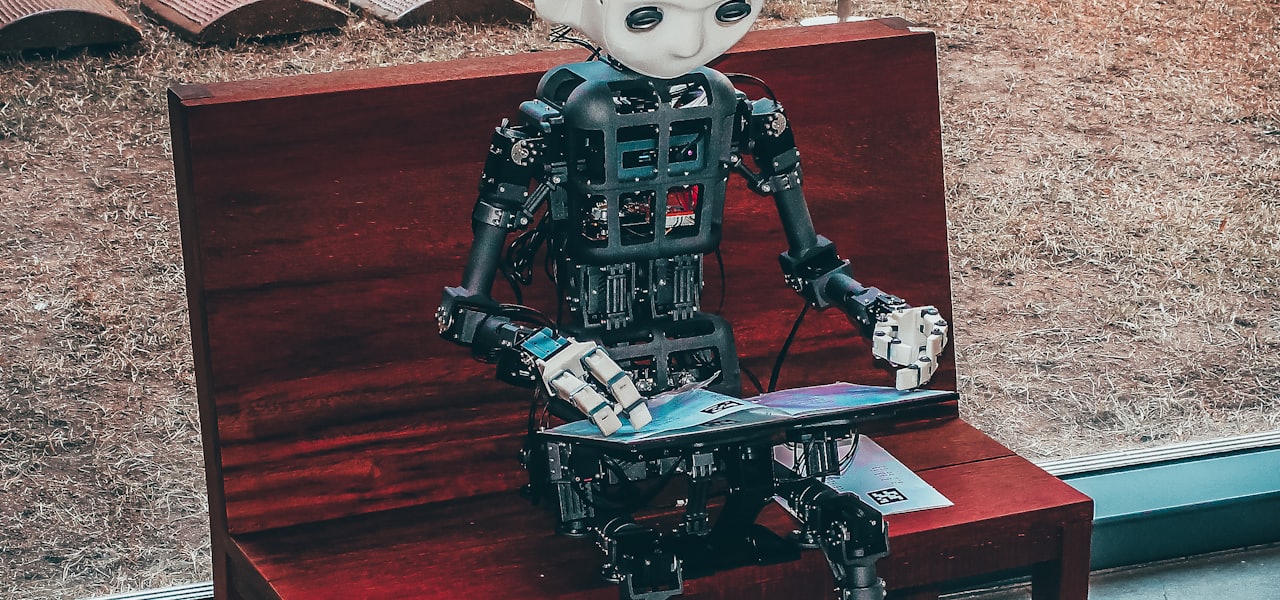
Cloud robotics is a field of robotics that attempts to invoke cloud technologies such as cloud computing, cloud storage, and other Internet technologies centered on the benefits of converged infrastructure and shared services for robotics. When connected to the cloud, robots can benefit from the powerful computation, storage, and communication resources of a modern data center in the cloud, which can process and share information from various robots or agents (other machines, smart objects, humans, etc.). Humans can also delegate tasks to robots remotely through networks. Cloud computing technologies enable robot systems to be gain capability whilst reducing costs through cloud technologies. Thus, it is possible to build lightweight, low-cost, smarter robots with an intelligent "brain" in the cloud. The "brain" consists of data center, knowledge base, task planners, deep learning, information processing, environment models, communication support, etc. == Components == A cloud for robots potentially has at least six significant components: Building a "cloud brain" for robots, the main object of cloud robotics; Offering a global library of images, maps, and object data, often with geometry and mechanical properties, expert system, knowledge base (i.e. semantic web, data centres); Massively-parallel computation on demand for sample-based statistical modelling and motion planning, task planning, multi-robot collaboration, scheduling and coordination of system; Robot sharing of outcomes, trajectories, and dynamic control policies and robot learning support; Human sharing of open-source code, data, and designs for programming, experimentation, and hardware construction; On-demand human guidance and assistance for evaluation, learning, and error recovery; Augmented human–robot interaction through various ways (semantics knowledge base, Apple SIRI like service, etc.). == Applications == Autonomous mobile robots Google's self-driving cars are cloud robots. The cars use the network to access Google's enormous database of maps and satellite and environment model (like Streetview) and combines it with streaming data from GPS, cameras, and 3D sensors to monitor its own position within centimetres, and with past and current traffic patterns to avoid collisions. Each car can learn something about environments, roads, or driving, or conditions, and it sends the information to the Google cloud, where it can be used to improve the performance of other cars. Cloud medical robots a medical cloud (also called a healthcare cluster) consists of various services such as a disease archive, electronic medical records, a patient health management system, practice services, analytics services, clinic solutions, expert systems, etc. A robot can connect to the cloud to provide clinical service to patients, as well as deliver assistance to doctors (e.g. a co-surgery robot). Moreover, it also provides a collaboration service by sharing information between doctors and care givers about clinical treatment. Assistive robots A domestic robot can be employed for healthcare and life monitoring for elderly people. The system collects the health status of users and exchange information with cloud expert system or doctors to facilitate elderly peoples life, especially for those with chronic diseases. For example, the robots are able to provide support to prevent the elderly from falling down, emergency healthy support such as heart disease, blooding disease. Care givers of elderly people can also get notification when in emergency from the robot through network. Industrial robots As highlighted by the German government's Industry 4.0 Plan, "Industry is on the threshold of the fourth industrial revolution. Driven by the Internet, the real and virtual worlds are growing closer and closer together to form the Internet of Things. Industrial production of the future will be characterised by the strong individualisation of products under the conditions of highly flexible (large series) production, the extensive integration of customers and business partners in business and value-added processes, and the linking of production and high-quality services leading to so-called hybrid products." In manufacturing, such cloud based robot systems could learn to handle tasks such as threading wires or cables, or aligning gaskets from a professional knowledge base. A group of robots can share information for some collaborative tasks. Even more, a consumer is able to place customised product orders to manufacturing robots directly with online ordering systems. Another potential paradigm is shopping-delivery robot systems. Once an order is placed, a warehouse robot dispatches the item to an autonomous car or autonomous drone to deliver it to its recipient. == Research == RoboEarth was funded by the European Union's Seventh Framework Programme for research, technological development projects, specifically to explore the field of cloud robotics. The goal of RoboEarth is to allow robotic systems to benefit from the experience of other robots, paving the way for rapid advances in machine cognition and behaviour, and ultimately, for more subtle and sophisticated human-machine interaction. RoboEarth offers a Cloud Robotics infrastructure. RoboEarth's World-Wide-Web style database stores knowledge generated by humans – and robots – in a machine-readable format. Data stored in the RoboEarth knowledge base include software components, maps for navigation (e.g., object locations, world models), task knowledge (e.g., action recipes, manipulation strategies), and object recognition models (e.g., images, object models). The RoboEarth Cloud Engine includes support for mobile robots, autonomous vehicles, and drones, which require much computation for navigation. Rapyuta is an open source cloud robotics framework based on RoboEarth Engine developed by the robotics researcher at ETHZ. Within the framework, each robot connected to Rapyuta can have a secured computing environment (rectangular boxes) giving them the ability to move their heavy computation into the cloud. In addition, the computing environments are tightly interconnected with each other and have a high bandwidth connection to the RoboEarth knowledge repository. FogROS2 is an open-source extension to the Robot Operating System 2 (ROS 2) developed by researchers at UC Berkeley. It enables robots to offload computationally intensive tasks—such as SLAM, grasp planning, and motion planning—to cloud resources, thereby enhancing performance and reducing onboard computational requirements. FogROS2 automates the provisioning of cloud instances, deployment of ROS 2 nodes, and secure communication between robots and cloud services. The platform is designed to be compatible with existing ROS 2 applications without requiring code modifications. Further advancements include FogROS2-SGC, which facilitates secure global connectivity across different networks and locations, and FogROS2-FT, which introduces fault tolerance by replicating services across multiple cloud providers to ensure robustness against failures. KnowRob is an extensional project of RoboEarth. It is a knowledge processing system that combines knowledge representation and reasoning methods with techniques for acquiring knowledge and for grounding the knowledge in a physical system and can serve as a common semantic framework for integrating information from different sources. RoboBrain is a large-scale computational system that learns from publicly available Internet resources, computer simulations, and real-life robot trials. It accumulates everything robotics into a comprehensive and interconnected knowledge base. Applications include prototyping for robotics research, household robots, and self-driving cars. The goal is as direct as the project's name—to create a centralised, always-online brain for robots to tap into. The project is dominated by Stanford University and Cornell University. And the project is supported by the National Science Foundation, the Office of Naval Research, the Army Research Office, Google, Microsoft, Qualcomm, the Alfred P. Sloan Foundation and the National Robotics Initiative, whose goal is to advance robotics to help make the United States more competitive in the world economy. MyRobots is a service for connecting robots and intelligent devices to the Internet. It can be regarded as a social network for robots and smart objects (i.e. Facebook for robots). With socialising, collaborating and sharing, robots can benefit from those interactions too by sharing their sensor information giving insight on their perspective of their current state. COALAS is funded by the INTERREG IVA France (Channel) – England European cross-border co-operation programme. The project aims to develop new technologies for disabled people through social and technological innovation and through the users' social and psychological integrity. The objective is to produce a cognitive ambient
Julia (programming language)
Julia is a dynamic general-purpose programming language. As a high-level language, distinctive aspects of Julia's design include a type system with parametric polymorphism, the use of multiple dispatch as a core programming paradigm, just-in-time compilation and a parallel garbage collection implementation. Notably, Julia does not support classes with encapsulated methods but instead relies on the types of all of a function's arguments to determine which method will be called. By default, Julia is run similarly to scripting languages, using its runtime, and allows for interactions, but Julia programs can also be compiled to small binary standalone executables (or to small libraries for e.g. Python), with e.g. the JuliaC.jl compiler. Julia programs can reuse libraries from other languages, and vice versa. Julia has interoperability with C, C++, Fortran, Rust, Python, and R. Additionally, some Julia packages have bindings to be used from Python and R as libraries. Julia is supported by programmer tools like IDEs (see below) and by notebooks like Pluto.jl, Jupyter, and since 2025, Google Colab officially supports Julia natively. Julia is sometimes used in embedded systems (e.g. has been used in a satellite in space on a Raspberry Pi Compute Module 4; 64-bit Pis work best with Julia, and Julia is supported in Raspbian). == History == Work on Julia began in 2009, when Jeff Bezanson, Stefan Karpinski, Viral B. Shah, and Alan Edelman set out to create a free language that was both high-level and fast. On 14 February 2012, the team launched a website with a blog post explaining the language's mission. In an interview with InfoWorld in April 2012, Karpinski said about the name of the language, Julia: "There's no good reason, really. It just seemed like a pretty name." Bezanson said he chose the name on the recommendation of a friend, then years later wrote: Maybe julia stands for "Jeff's uncommon lisp is automated"? Julia's syntax is stable, since version 1.0 in 2018, and Julia has a backward compatibility guarantee for 1.x and also a stability promise for the documented (stable) API, while in the years before in the early development prior to 0.7 the syntax (and semantics) was changed in new versions. All of the (registered package) ecosystem uses the new and improved syntax, and in most cases relies on new APIs that have been added regularly, and in some cases minor additional syntax added in a forward compatible way e.g. in Julia 1.7. In the 10 years since the 2012 launch of pre-1.0 Julia, the community has grown. The Julia package ecosystem has over 11.8 million lines of code (including docs and tests). The JuliaCon academic conference for Julia users and developers has been held annually since 2014 with JuliaCon2020 welcoming over 28,900 unique viewers, and then JuliaCon2021 breaking all previous records (with more than 300 JuliaCon2021 presentations available for free on YouTube, up from 162 the year before), and 43,000 unique viewers during the conference. Three of the Julia co-creators are the recipients of the 2019 James H. Wilkinson Prize for Numerical Software (awarded every four years) "for the creation of Julia, an innovative environment for the creation of high-performance tools that enable the analysis and solution of computational science problems." Also, Alan Edelman, professor of applied mathematics at MIT, has been selected to receive the 2019 IEEE Computer Society Sidney Fernbach Award "for outstanding breakthroughs in high-performance computing, linear algebra, and computational science and for contributions to the Julia programming language." Version 0.3 was released in August 2014. Both Julia 0.7 and version 1.0 were released on 8 August 2018. Julia 1.4 added syntax for generic array indexing to handle e.g. 0-based arrays. The memory model was also changed. Julia 1.5 released in August 2020 added record and replay debugging support, for Mozilla's rr tool. The release changed the behavior in the REPL (to soft scope) to the one used in Jupyter, but keeps full compatible with non-REPL code (that retains hard scope). Julia 1.6 was the largest release since 1.0, and it was the long-term support (LTS) version for the longest time. Since Julia 1.7 development is back to time-based releases, and it was released in November 2021 with e.g. a new default random-number generator and Julia 1.7.3 fixed at least one security issue. Julia 1.8 added options for hiding source code when compiling Julia source code to executables. Julia 1.9 has added the ability to precompile packages to native machine code, done automatically; to improve precompilation of packages a new package PrecompileTools.jl was introduced, for use by package developers. Julia 1.10 was released on 25 December 2023 with new features such as parallel garbage collection. Julia 1.11 was released on 7 October 2024, and with it 1.10.5 became the next long-term support (LTS) version (i.e. those became the only two supported versions), since replaced by 1.10.10 released on 27 June, and 1.6 is no longer an LTS version. Julia 1.11 adds e.g. the new public keyword to signal safe public API (Julia users are advised to use such API, not internals, of Julia or packages, and package authors advised to use the keyword, generally indirectly, e.g. prefixed with the @compat macro, from Compat.jl, to also support older Julia versions, at least the LTS version). Julia 1.12 was released on 7 October 2025 (and 1.12.5 on 9 February 2026), and with it a JuliaC.jl package including the juliac compiler that works with it, for making rather small binary executables (much smaller than was possible before; through the use of new so-called trimming feature). Julia 1.10 LTS is an officially still-supported branch, but the 1.11 branch has also been maintained after 1.12 release, with 1.11.8 released and then 1.11.9 released on 8 February 2026. === JuliaCon === Since 2014, the Julia Community has hosted an annual Julia Conference focused on developers and users. The first JuliaCon took place in Chicago and kickstarted the annual occurrence of the conference. Since 2014, the conference has taken place across a number of locations including MIT and the University of Maryland, Baltimore. The event audience has grown from a few dozen people to over 28,900 unique attendees during JuliaCon 2020, which took place virtually. JuliaCon 2021 also took place virtually with keynote addresses from professors William Kahan, the primary architect of the IEEE 754 floating-point standard (which virtually all CPUs and languages, including Julia, use), Jan Vitek, Xiaoye Sherry Li, and Soumith Chintala, a co-creator of PyTorch. JuliaCon grew to 43,000 unique attendees and more than 300 presentations (still freely accessible, plus for older years). JuliaCon 2022 will also be virtual held between July 27 and July 29, 2022, for the first time in several languages, not just in English. === Sponsors === The Julia language became a NumFOCUS fiscally sponsored project in 2014 in an effort to ensure the project's long-term sustainability. Jeremy Kepner at MIT Lincoln Laboratory was the founding sponsor of the Julia project in its early days. In addition, funds from the Gordon and Betty Moore Foundation, the Alfred P. Sloan Foundation, Intel, and agencies such as NSF, DARPA, NIH, NASA, and FAA have been essential to the development of Julia. Mozilla, the maker of Firefox web browser, with its research grants for H1 2019, sponsored "a member of the official Julia team" for the project "Bringing Julia to the Browser", meaning to Firefox and other web browsers. The Julia language is also supported by individual donors on GitHub. === The Julia company === JuliaHub, Inc. was founded in 2015 as Julia Computing, Inc. by Viral B. Shah, Deepak Vinchhi, Alan Edelman, Jeff Bezanson, Stefan Karpinski and Keno Fischer. In June 2017, Julia Computing raised US$4.6 million in seed funding from General Catalyst and Founder Collective, the same month was "granted $910,000 by the Alfred P. Sloan Foundation to support open-source Julia development, including $160,000 to promote diversity in the Julia community", and in December 2019 the company got $1.1 million funding from the US government to "develop a neural component machine learning tool to reduce the total energy consumption of heating, ventilation, and air conditioning (HVAC) systems in buildings". In July 2021, Julia Computing announced they raised a $24 million Series A round led by Dorilton Ventures, which also owns Formula One team Williams Racing, that partnered with Julia Computing. Williams' Commercial Director said: "Investing in companies building best-in-class cloud technology is a strategic focus for Dorilton and Julia's versatile platform, with revolutionary capabilities in simulation and modelling, is hugely relevant to our business. We look forward to embedding Julia Computing in the world's most technologically advanced sport". In June 2023, JuliaHub received (again, now